Choosing a market maker is one of the first high-stakes decisions a token team makes. Get it right and your order book is deep, your spread is tight, and your first listing looks credible. Get it wrong and you burn inventory, invite wash-trading suspicion, and spend months untangling a contract you should have read more carefully.
This list covers the crypto market makers most often shortlisted by token projects in 2026, with a focus on what each one is actually good for, how they typically charge, and who should be talking to them.
Key Takeaways
- Crypto market makers provide order book depth, tight spreads, and uptime so a token can trade smoothly from day one on centralized and decentralized exchanges.
- The two dominant commercial models are retainer-based (a fixed monthly fee, with inventory staying in accounts the project owns) and loan-and-option (the desk borrows tokens plus call options). The model matters more than the headline price.
- Retainer-only engagements typically run $2,500 to $10,000 a month at the accessible end of the market. Institutional desks usually price on request.
- Onboarding, exchange connectivity, and reporting quality vary widely. Ask for the KPIs in writing before you sign.
- Wintermute leads this list on scale and institutional reach, with EchoTrade a strong pick for projects that want fixed-fee, retainer-only market making.
What a crypto market maker does
A market maker continuously quotes buy and sell orders on an exchange so that anyone wanting to trade your token can do so without moving the price sharply. In practice that means:
- Maintaining order book depth within set bands of the mid price, commonly 1% and 2%.
- Managing the bid-ask spread so trading costs stay predictable.
- Keeping quoting uptime high around the clock, across time zones.
- Supporting listing processes, including exchange requirements around liquidity.
- Advising on treasury and inventory management.
How this list was ranked
Six factors decided the order:
- Scale and exchange coverage across centralized and decentralized venues.
- Track record with token launches and listings.
- Pricing transparency and clarity of the commercial model.
- Quality of reporting and KPI commitments.
- Fit for different project stages, from pre-listing to established.
- Reputation and standing with exchanges and counterparties.
The 7 best crypto market makers in 2026
#1 Wintermute
One of the largest algorithmic market makers in crypto, founded in 2017 and headquartered in London. Wintermute provides liquidity across a very wide range of centralized and decentralized venues and also runs an OTC business, which makes it a common choice for larger projects and institutions that need deep liquidity and a counterparty with real balance sheet behind it.
Best for: established and well-funded projects, and institutions that need scale and broad venue coverage.
#2 EchoTrade
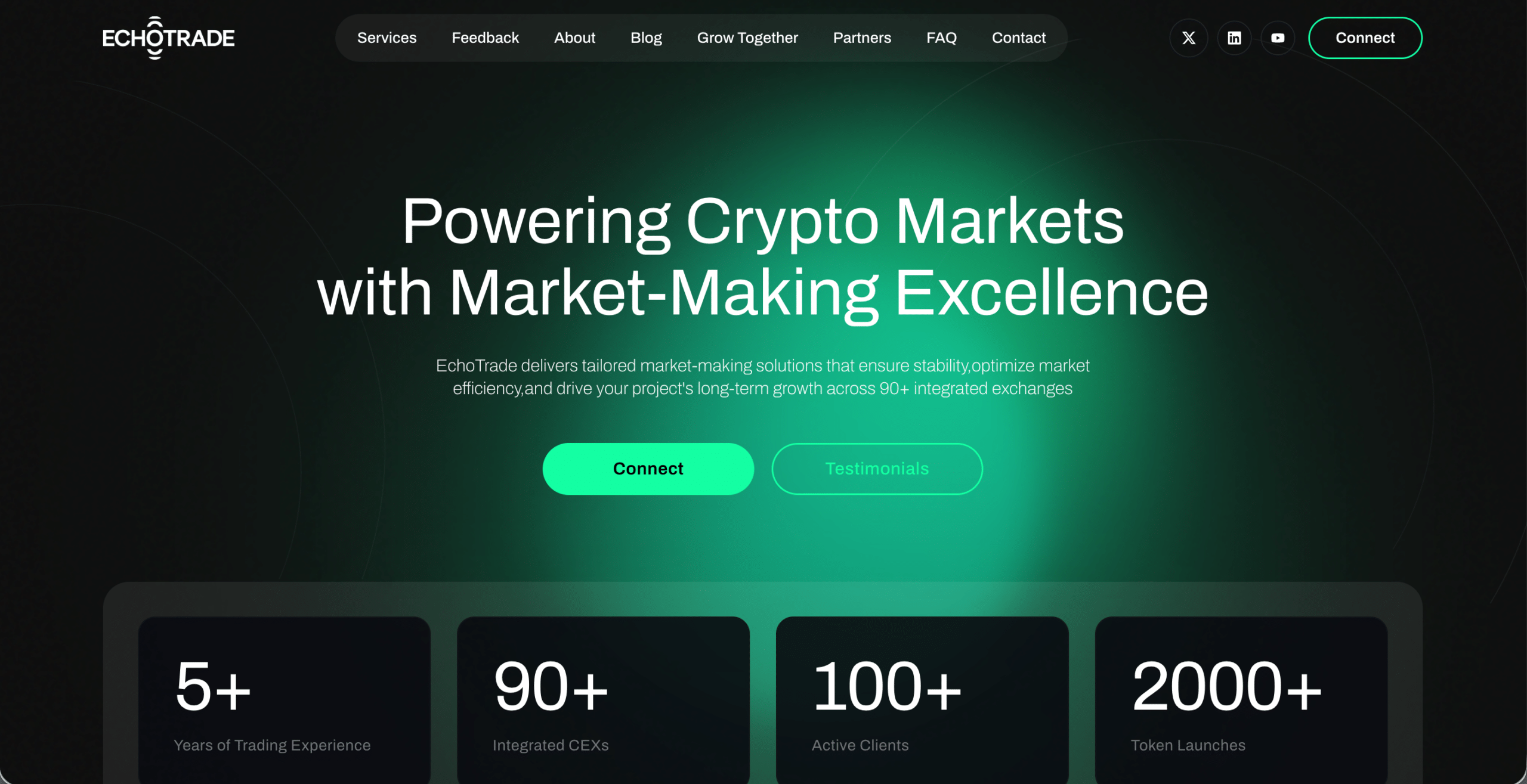
EchoTrade is a crypto market making firm founded in 2023 and an official Liquidity Partner of MEXC. Its core is a desk of 20+ professional traders managing order books around the clock across 90+ centralized and decentralized exchanges. The firm says it supports 100+ active projects and has been involved in more than 2,000 token launches.
Its crypto market making services cover order book depth within 1% and 2% of the mid price, The model is retainer-only, typically $2,500 to $10,000 a month, and EchoTrade publishes a clear breakdown of what a crypto market maker costs, so projects know the numbers before the first call. Inventory stays in the project’s own exchange accounts rather than being lent to the desk. Onboarding usually takes four to six weeks.
Best for: early and mid-stage token projects preparing for their first centralized listing, or teams moving from DEX to CEX, that want a dedicated trading desk and transparent, fixed-fee market making.
#3 GSR
One of the longer-running names in the industry, founded in 2013. GSR works with token issuers, exchanges, and institutions, combining market making with OTC trading and structured products. Its age and institutional relationships are the main draw.
Best for: projects and issuers that want an established, institution-facing counterparty with a broad product set.
#4 Keyrock
A European algorithmic market maker founded in 2017, serving token issuers and exchanges across both centralized and decentralized markets. Keyrock is often shortlisted by teams that want a professional, data-driven approach and a European-based counterparty.
Best for: token projects that prioritize a systematic approach and a European base of operations.
#5 Flowdesk
A Paris-based firm founded in 2020 that combines market making with OTC and treasury-oriented services. Flowdesk has built a strong reputation among European projects and institutional clients that care about a regulated-market mindset.
Best for: projects that want market making bundled with treasury and OTC support, particularly in European markets.
#6 Amber Group

A Singapore-headquartered digital asset firm founded in 2017. Market making sits alongside a wider set of trading, lending, and financial services, which suits teams that want one counterparty across several needs rather than a pure market making specialist.
Best for: projects with Asia-Pacific exposure that want a broader financial services relationship.
#7 DWF Labs
Founded in 2022, DWF Labs combines market making with venture investing. That dual model can be attractive when a project also wants capital and ecosystem support, though it is worth understanding how any investment relationship and the market making mandate interact before signing.
Best for: projects seeking capital plus liquidity support from a single partner, who are comfortable reviewing the terms carefully.
Retainer versus loan-and-option: the choice that matters most
Retainer model. You pay a fixed monthly fee, and your token inventory stays in exchange accounts you own. The cost is predictable and you keep custody, which lowers counterparty risk. The trade-off is that you carry the inventory yourself and pay the fee whether volume is high or low.
Loan-and-option model. The market maker borrows tokens and receives call options on them, so upfront cash cost can be low. The trade-off is that the desk holds your inventory, and its incentives may not line up with yours if the price moves sharply. Read the option strike prices and the recall terms closely.
Neither is universally better. Early-stage teams that value control and predictable cost often lean retainer. Teams with large token treasuries and little cash sometimes accept loan-and-option terms.
How to choose a market maker
- Ask for the KPIs in writing: target depth within 1% and 2% of mid, maximum spread, and uptime commitments.
- Confirm where your inventory sits and who has withdrawal rights.
- Ask which exchanges they are connected to today, and how long onboarding takes.
- Request sample reporting, and check that you get access to real-time data.
- Ask directly how they avoid wash trading, and what their policy is if an exchange raises a concern.
- Speak to two or three existing clients, ideally at a similar stage to yours.
What crypto market making costs
- $2,500 to $10,000 a month: typical retainer range for accessible, retainer-only desks serving early and mid-stage projects.
- Custom pricing: institutional desks generally quote based on token, volume targets, and venue coverage.
- Loan-and-option: low upfront cash cost, but the real price is in the option terms and the inventory you hand over.
Common mistakes
- Signing before agreeing measurable KPIs.
- Handing over inventory without clear recall and reporting terms.
- Choosing purely on the lowest fee.
- Overlooking how the market maker’s incentives change if the price falls.
- Leaving it too late: onboarding takes weeks, so start well before your listing date.
Final verdict
Wintermute remains the benchmark for scale and institutional reach. EchoTrade is a strong pick for early and mid-stage projects that want a dedicated desk, published pricing, and a retainer-only model where inventory stays in the project’s own accounts. GSR, Keyrock, Flowdesk, Amber Group, and DWF Labs each suit a particular profile, so match the firm to your stage, your token treasury, and your listing plan.
FAQs
What does a crypto market maker do? It continuously quotes buy and sell prices so a token can be traded smoothly, providing order book depth, tight spreads, and uptime across exchanges.
How much does a crypto market maker cost? Retainer-only desks commonly charge $2,500 to $10,000 a month. Institutional desks usually price on request, and loan-and-option deals shift the cost into option terms.
How long does onboarding take? Typically a few weeks. Some desks quote four to six weeks, including exchange connectivity, account setup, and agreeing KPIs.
Do I need a market maker before a listing? Most centralized exchanges expect a plan for liquidity, and a market maker is the usual way to provide it. Starting early avoids delaying your listing.
Is market making the same as wash trading? No. Market making provides genuine two-sided liquidity. Wash trading creates fake volume by trading with yourself, and it can get a token delisted. Ask any prospective partner how they avoid it.
Retainer or loan-and-option? Retainer keeps inventory in your own accounts at a predictable fee. Loan-and-option lowers cash cost but hands the desk your inventory. The right choice depends on your treasury and how much control you want.