Looking for a Crypto SEO Agency?
Crypto SEO has changed more in the last 18 months than in the previous decade.
The buyer crossed over from crypto-native to fintech-grade. The answer-engine layer – ChatGPT, Perplexity, Gemini, Google’s AI Overviews – emerged as a new and largely uncontested research surface where shortlists get built before a buyer ever sees a SERP. And the agentic web arrived, with autonomous AI agents discovering, evaluating, and increasingly transacting on programmable money rails only crypto has at scale.
A 2026-grade crypto SEO strategy has to win all three surfaces – classic search, answer engines, and agents – without compromising on any one of them. Most frameworks in circulation were built for one surface, glue a second on awkwardly, and treat the third as a future problem. This is a working framework that addresses all three head-on.
It’s structured for crypto, blockchain, stablecoin, exchange, wallet, and Web3 companies that need a defensible model – not a checklist – to organize their search and AI-citation work for the next 24 months.
The framework in one line
The Crypto Search Stack: 7 Layers × 3 Surfaces × 1 Measurement Loop.
Seven disciplines stacked bottom-to-top, each engineered to perform across three search surfaces (blue-link, answer engine, agent), all bound by one integrated measurement loop that ties rankings, AI citations, and pipeline together.
Why crypto SEO and AEO need a unified framework in 2026
Three structural shifts forced the rewrite of crypto search strategy.
The buyer changed. The marginal buyer of crypto infrastructure today is a fintech operator – a treasurer, a CFO, a head of payments, an RIA, a product lead at a marketplace, a compliance officer at a custodian. They research like underwriters. They want documentation, named experts, audited claims, regulatory clarity, and comparison content. That moves crypto pages onto YMYL turf and into fintech-grade SERPs.
The search ecosystem fragmented. Classic blue-link SERPs are now joined by answer engines as a parallel research surface. A large and growing share of high-intent crypto research starts inside ChatGPT, Perplexity, Gemini, or Google AI Overviews – the buyer reads a synthesized answer with a handful of cited sources before clicking anywhere. Optimizing for blue-link search alone makes you invisible at the exact moment a shortlist is set.
The agentic web arrived. Autonomous AI agents are now a measurable user segment on crypto sites. They navigate, evaluate, and – uniquely for crypto, because the money is programmable – transact. Optimizing for them is a different discipline again: machine-readable everything, public APIs, MCP servers, agent-aware analytics, action-completable flows.
A 2026 crypto SEO framework has to hold all three together. That is what this framework does.
What is crypto AEO and how is it different from crypto SEO?
Crypto SEO is the discipline of ranking pages in classic search engines (Google, Bing). Crypto AEO – Answer Engine Optimization – is the discipline of being cited as a source by AI answer engines (ChatGPT, Perplexity, Gemini, Google AI Overviews). They share most of the same foundations but reward overlapping-but-distinct moves on the content and authority layers.
Crypto GEO (Generative Engine Optimization) is closely related to AEO and used interchangeably in practice. Where AEO emphasizes being a citation source, GEO frames the broader work of being found, trusted, and represented inside generative engines. Both are measured by a recurring prompt battery and tracked through citation share, mention share, and risk-flag rate per engine.
The framework treats SEO, AEO, and GEO not as competing programs but as three surfaces the same seven layers serve. That is the unlock.
The 7 layers of the crypto SEO framework
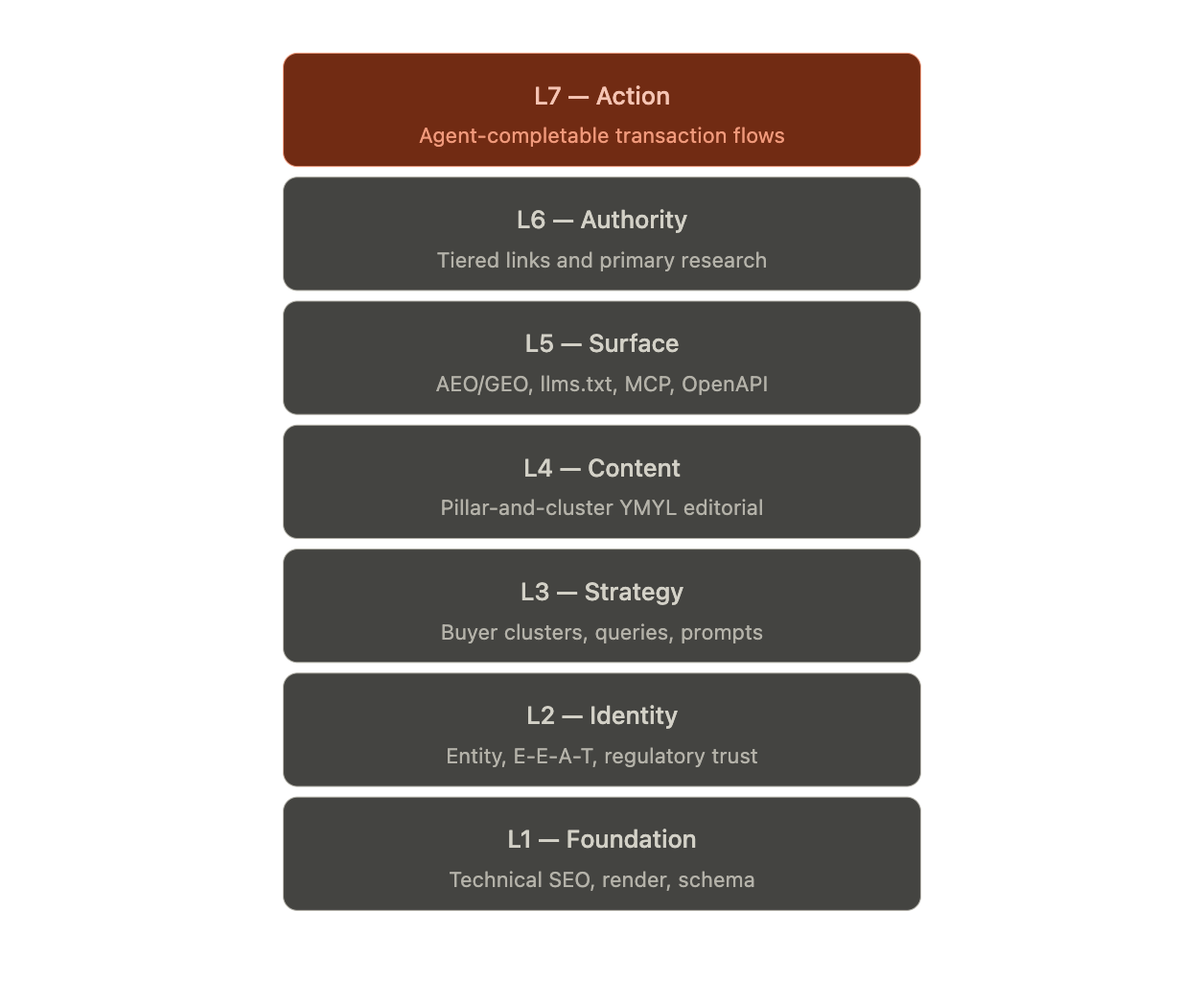
Each layer is a complete discipline. Each has a purpose, a “what good looks like” standard, and an output that feeds the layer above it. Skipping layers caps the program – Layer 5 doesn’t compound without Layer 4, which doesn’t compound without Layer 3, and so on.
Layer 1 – Foundation: technical SEO for crypto sites
Purpose: Make the site crawlable, fast, machine-readable, and indexation-clean across every surface.
What good looks like: server-side rendering for critical content; Core Web Vitals on green; clean information architecture; deliberate indexation control (canonicals, noindex on thin pages, tidy XML sitemaps); a comprehensive schema deployment – Organization, Service, FinancialProduct or FinancialService, FAQPage, Article, BreadcrumbList, HowTo where applicable; a considered per-bot robots.txt that allows or disallows GPTBot, ClaudeBot, PerplexityBot, and Google-Extended deliberately, not by default; hreflang implemented correctly for international footprints.
Output to Layer 2: a clean, crawlable, machine-parseable surface the rest of the stack can build on.
Layer 2 – Identity: E-E-A-T and entity for crypto YMYL
Purpose: Build the entity, the credentials, and the regulatory clarity that earn trust on YMYL surfaces.
Crypto’s cultural defaults – anonymous founders, pseudonymous bylines, faceless brands – are a structural disadvantage on every surface that matters. Layer 2 is the work of becoming a verifiable, citable, named entity that Google’s quality systems, the answer engines, and the agents can all trust.
What good looks like: a deep Organization schema block sitewide with legal name, addresses, founding date, licenses, executive team, and sameAs links to verified profiles; a substantive About page that names humans and lists credentials; a security and compliance hub linking real third-party audit reports, SOC reports, and proof-of-reserves where applicable; named author bylines with verifiable expertise on every money page; consistent entity language across the site; regulatory disclosure that reads like a bank’s, not a startup’s.
Output to Layer 3: a trust surface the rest of the stack can hang authoritative content from.
Layer 3 – Strategy: crypto keyword research and AI prompt mapping
Purpose: Map the buyer, the queries, and the prompts that actually move revenue. Stop publishing for anyone else.
What good looks like: a named set of buyer clusters specific to the business (e.g., for a stablecoin platform: Issuers, Fintechs adding rails, Marketplaces, Treasurers, Enterprise integrators, Cross-border operators); a priority query list of 80–150 queries per cluster, scored on search volume, intent strength for the business, and ranking difficulty against the actual SERP, sorted by intent first; a parallel AI-prompt list of 30–60 natural-language questions buyers would actually type into ChatGPT, Perplexity, Gemini, or AI Overviews; both maps refreshed quarterly.
Output to Layer 4: a content roadmap that pays back, not a content calendar that fills slots.
Layer 4 – Content: pillar-and-cluster for crypto YMYL
Purpose: Ship YMYL-grade, pillar-and-cluster content that compounds across surfaces.
Scattered posts do not compound. Pillar-and-cluster does. Layer 4 is where the priority map from Layer 3 turns into publishable, ranking, citation-eligible assets.
What good looks like: one definitive pillar page per priority cluster (3,000–5,000 words); 8–12 supporting articles (1,500–2,500 words each); one comparison hub (you vs. up to four named alternatives); one glossary owning definitional queries; one primary-research page with original data; one regulatory companion where the topic demands it. All internally linked. Every piece bylined by a named author with verifiable expertise. Every claim sourced to a primary reference (whitepaper, BIP, regulator publication, a16z, Castle Island, Coin Metrics, Galaxy, Fidelity Digital Assets, or a regulator filing). Every piece structured for extraction. Updated quarterly with a visible “last updated” date.
Output to Layer 5: a body of content engineered to win blue-link rankings and feed the answer engines.
Layer 5 – Surface: AEO, GEO, and agent readiness
Purpose: Engineer for the three search surfaces specifically – blue-link, answer engine, and agent.
This is the layer most crypto search programs simply do not have. They optimize for Google and hope everything else works. It doesn’t.
What good looks like: classic on-page SEO done right (title tags, meta descriptions, internal linking, schema); AEO/GEO mechanics – inverted-pyramid sections, question-shaped headings, self-contained quotable facts, consistent entity language, ruthless freshness on YMYL topics; agent-readiness – a /llms.txt file at root, considered per-bot robots directives, a public versioned OpenAPI spec, an MCP server exposing top read-only capabilities, a /.well-known/agent.json-style manifest pointing agents at the API, MCP, llms.txt, pricing, and support surfaces; real numbers on the pricing page with last-verified dates; machine-readable comparison tables in HTML, not images.
Output to Layer 6: a content surface that’s not just rankable but lift-able by the answer engines and usable by agents.
Layer 6 – Authority: crypto link building and analyst relations
Purpose: Earn mentions on the sources the engines and agents already trust.
Crypto links and mentions are not fungible. A single placement on a16z, Castle Island, Coin Metrics, Galaxy, Fidelity Digital Assets, BIS, IMF, FSB, Bloomberg, CoinDesk’s policy or Bitcoin desk, Bitcoin Magazine, The Block research, or a named regulator filing moves more than a hundred low-grade crypto-blog links.
What good looks like: a tiered link target list (three tiers, named outlets per tier, refreshed quarterly); original primary research that earns citations on cadence (corridor flow studies, custody benchmarks, treasury surveys, Lightning revenue analyses, ETF flow breakdowns, on-chain volume studies); analyst-relations briefings with named researchers on a calendar cadence; expert commentary placement into the reactive PR cycle; honest comparison content; zero participation in PR-wire syndication or guest-post networks; the mention graph monitored monthly.
Output to Layer 7: an authority profile that earns citation share in the engines and trust in the agents.
Layer 7 – Action: optimizing for AI agents and programmatic commerce
Purpose: Build transaction-completable flows for the agentic web.
This is the layer crypto can win that no other category can. Programmable money lets agents not just discover and evaluate but act – sign, pay, settle, custody, swap, withdraw – without a human in the loop.
What good looks like: at least one production-grade transaction flow that a delegated agent can complete end-to-end on a sanctioned API path; scoped API keys with explicit permission models; session-key or signed-intent patterns with bounded scope; HTTP 402 / x402-style payment-required patterns where appropriate; wallet auth flows that work for delegated agents; a documented agent-auth model, a public kill switch, and a security posture that assumes prompt injection is a live threat; agent-aware analytics that classify agent traffic as a distinct class and measure agent revenue separately.
Output to the measurement loop: a closed feedback path from search and answer-engine discovery all the way to programmatic revenue.
The 3 surfaces of crypto search in 2026
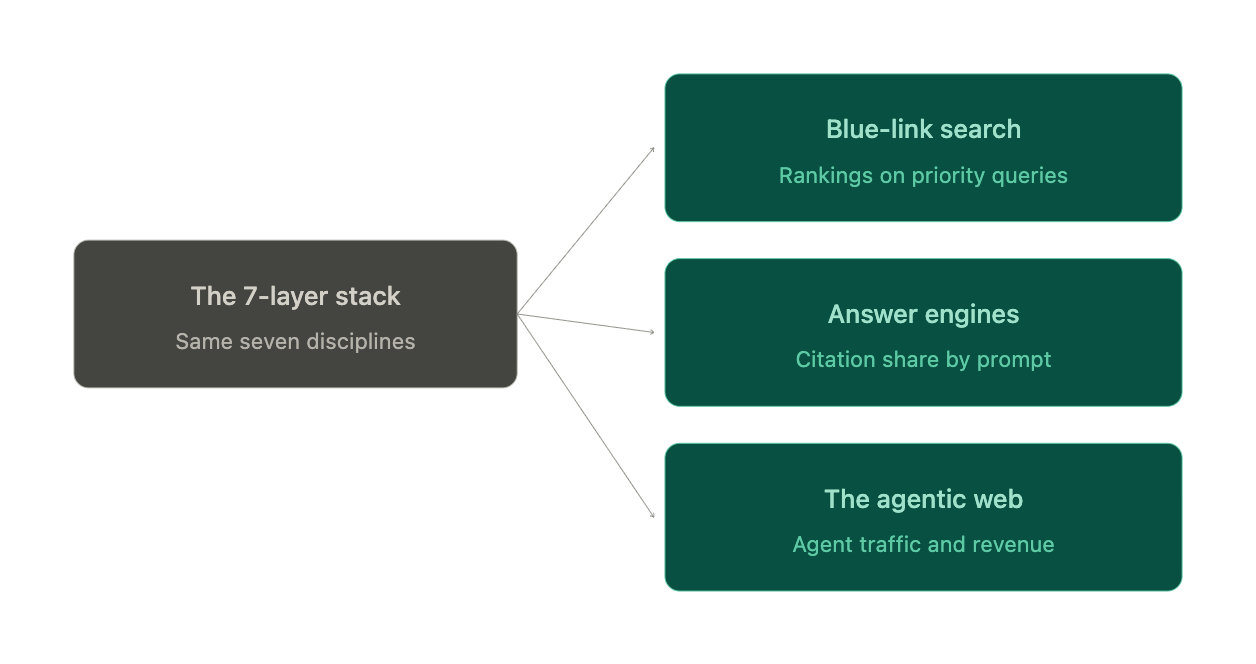
The same seven layers perform across three surfaces. The framework holds because the underlying disciplines hold – what changes is the emphasis, the trust signal, and the success metric.
Surface A – Blue-link search (Google, Bing)
Still where the largest share of high-intent informational and comparative search lives, especially for institutional and prosumer buyers who research methodically. Rewards: technical hygiene, depth of content, internal linking, named-author E-E-A-T, freshness, third-party authority, exact-match user-intent satisfaction.
Success metric: rankings on the priority query list from Layer 3. Tracked weekly. Watched for SERP feature appearance – featured snippets, People Also Ask, Knowledge Panel, and AI Overview presence.
Surface B – Answer engines (ChatGPT, Perplexity, Gemini, AI Overviews)
The new and largely uncontested research surface where shortlists get built before a buyer sees a SERP. Rewards: extractable answers, question-shaped headings, schema, self-contained quotable statements, consistent entity language, third-party mentions on the sources the models trust, freshness.
Success metric: AI citation share against a defined prompt battery, run on a fixed cadence across each major engine. Tracked monthly minimum, weekly for hot clusters. Watched alongside mention share (named without link) and risk-flag rate (mentioned negatively or with a competitor’s caveat).
Surface C – The agentic web (autonomous AI agents)
The newest, fastest-growing surface, where crypto has structural advantages no other category has. Rewards: discoverability (Layer 1 + Layer 5), trust (Layer 2 + Layer 6), usability (Layer 5 – OpenAPI, MCP, llms.txt), and action-completability (Layer 7).
Success metric: agent traffic share, agent funnel completion, and agent-attributed revenue. Tracked monthly. The number is small today and growing fast. The slope is what matters.
The 1 measurement loop

The same loop binds all three surfaces. Three reading points and one decision step.
Reading 1 – Rankings. Where does the priority query list stand this week? Movement, volatility, SERP feature appearance.
Reading 2 – Citations. What does the prompt battery show this month? Citation share, mention share, risk-flag rate per engine, per cluster.
Reading 3 – Pipeline. What converted? Demos, account opens, API signups, sandbox starts, RFP starts, contract starts, agent-completed transactions. Tied to organic, AI-referral, and agent sessions via server-side analytics, UTM discipline that survives sales handoff, and warehouse joins.
Decision step – Recalibrate. Quarterly, the three readings feed back into Layer 3. The priority query list and the prompt battery get re-scored. Underperforming pillars get refreshed or retired. Over-performing clusters get extended. Layer 7 flows get expanded. The roadmap moves.
A program without the loop is theater. A program with the loop compounds.
The 7 × 3 implementation matrix
Twenty-one working modules. Every layer × every surface. This is the table to organize the work around and to score the program against.
How to use the framework
Three working modes.
As a diagnostic. Score the program on a 0–5 scale across each of the 21 cells. The lowest-scoring layer determines the ceiling – until Layer 1 hits 3+, Layer 5 won’t compound; until Layer 2 hits 3+, Layer 6 placements won’t be cited. Most crypto programs score 2 or under on Layers 5 and 7, which is why every other layer underperforms.
As a roadmap. The 90-day starting sequence is always: foundation + identity (Layers 1–2) first, then map (Layer 3), then build (Layer 4 + 5), then earn (Layer 6), then close (Layer 7), then measure (the loop). Six sprints, twelve weeks, twenty-one modules.
As a scoping structure. Engagements and internal workstreams map cleanly to the matrix. A “Foundation + Identity” sprint is a finite, measurable engagement. An “AEO/GEO across content + surface” workstream is too. An “Agent readiness” workstream is the Layer 5 + Layer 7 columns of the agent surface. The framework lets teams scope the slice they need without having to swallow the whole thing.
FAQ
What is crypto SEO? Crypto SEO is the discipline of ranking crypto, blockchain, stablecoin, exchange, wallet, and Web3 company pages in search engines (Google, Bing). In 2026 it has become a YMYL discipline competing against fintechs and banks, not just other crypto sites, which raises the trust bar and weights named-entity signals more heavily than generic SEO.
What is crypto AEO? Crypto AEO – Answer Engine Optimization for crypto – is the discipline of being cited as a source by AI answer engines (ChatGPT, Perplexity, Gemini, Google AI Overviews) on crypto queries. It overlaps with SEO on the technical and content layers but adds a measurement layer (the prompt battery and citation share) and a distinct content-structuring discipline (extractable answers, question-shaped headings, machine-readable facts).
How is crypto AEO different from crypto SEO? Crypto SEO targets ranking in blue-link SERPs. Crypto AEO targets citation by AI answer engines. The disciplines share most foundations but reward overlapping-but-distinct moves on content structure and authority. A 2026-grade program runs both inside a single framework rather than treating them as separate programs.
Why does crypto need its own SEO framework in 2026? Three structural shifts – the buyer becoming fintech-grade, the answer-engine layer emerging as a parallel research surface, and the agentic web arriving with programmable-money advantages crypto uniquely has. Generic SEO frameworks were built before these shifts and don’t cover all three surfaces.
What is the difference between AEO and GEO? AEO (Answer Engine Optimization) emphasizes being a citation source inside AI answer surfaces. GEO (Generative Engine Optimization) frames the broader work of being found, trusted, and represented inside generative engines. In practice the terms are used interchangeably and the tactics overlap heavily.
What is YMYL in crypto SEO? YMYL stands for “Your Money or Your Life” – Google’s category for content that can affect a person’s finances or wellbeing. Crypto pages are unambiguously YMYL because they’re about money, custody, payments, yield, and risk. That raises the quality bar and weights E-E-A-T (experience, expertise, authoritativeness, trust) signals more heavily.
How long does crypto SEO take to work? Foundational and AEO/GEO wins typically show inside the first quarter. Meaningful authority-driven ranking gains and pipeline contribution compound over two to three quarters as clusters mature and trust signals accrue. It is a moat, not a hack.
How do you measure AI citations in crypto? Build a recurring prompt battery – 30–60 natural-language buyer questions per cluster – and run it across ChatGPT, Perplexity, Gemini, and Google AI Overviews on a fixed cadence (monthly minimum, weekly for hot clusters). Log citation share, mention share, and risk-flag rate per engine.
What is the role of AI agents in crypto SEO? AI agents are increasingly a third class of “user” – autonomous software acting on a person’s behalf. Crypto sites optimized for agents are discoverable (Layer 1), trusted (Layer 2 + 6), usable (Layer 5 – OpenAPI, MCP, llms.txt), and action-completable (Layer 7). Crypto is the first category where the agent can be a full commercial actor, because the money is programmable.
What does a 90-day crypto SEO and AEO program look like? Sprint 1 (foundation: Layers 1–2). Sprint 2 (map: Layer 3). Sprint 3 (pillar: first cluster). Sprint 4 (cluster: supporting articles). Sprint 5 (authority: Layer 6 outreach). Sprint 6 (instrument and measure: pipeline attribution, first monthly executive report). Six sprints, twelve weeks, the full stack standing up in measurable form.
The takeaway
Crypto search is no longer one discipline. It is three surfaces (blue-link search, answer engines, the agentic web) running on seven shared layers (foundation, identity, strategy, content, surface, authority, action) and bound by one measurement loop (rankings → citations → pipeline → recalibrate).
A program that addresses one surface and ignores the others is increasingly a program that compounds in one place and quietly loses ground in the other two. A program that runs all three through the same stack compounds everywhere.
Score the program. Pick the lowest layer. Ship the next sprint. Run the loop.
This framework is published by ColdChain, a performance-first SEO, AEO, GEO, and agent-readiness agency for crypto, blockchain, stablecoin, exchange, wallet, and DeFi companies. To audit a program against the framework, get in touch →.
Sources & further reading: Google Search Quality Rater Guidelines (YMYL, E-E-A-T); a16z, Castle Island, Coin Metrics, Galaxy, Fidelity Digital Assets stablecoin and crypto research; Anthropic Model Context Protocol documentation; emerging llms.txt and HTTP 402 / x402 patterns.


