

Looking for a Crypto SEO Agency?
Crypto SEO has changed more in the last 18 months than in the previous decade. The marginal buyer crossed over from crypto-native to fintech-grade. The answer-engine layer – ChatGPT, Perplexity, Gemini, Google AI Overviews – emerged as a new and largely uncontested research surface where shortlists get built before a buyer ever sees a SERP. And the agentic web arrived, with autonomous AI agents discovering, evaluating, and increasingly transacting on programmable money rails only crypto has at scale.
A 2026-grade crypto SEO program has to win all three surfaces – classic blue-link search, answer engines, and agents – without compromising on any one of them. Most working “crypto SEO” guides on the web were built for one surface, glue a second on awkwardly, and treat the third as a future problem. This is the complete working guide for the 2026 reality.
It’s structured for crypto, blockchain, stablecoin, exchange, wallet, DeFi, and Web3 projects that need a defensible model, not a checklist.
Key takeaways
- Crypto SEO is the discipline of ranking and getting cited – in classic search engines, AI answer engines, and increasingly with autonomous agents – for the queries that crypto buyers, developers, and institutions actually run.
- Crypto content sits squarely inside Google’s YMYL (Your Money or Your Life) category, which raises the quality threshold and weights E-E-A-T (Experience, Expertise, Authoritativeness, Trust) signals more heavily than generic SEO.
- The marginal buyer of crypto infrastructure in 2026 is a fintech operator (CFO, treasurer, head of payments, RIA, marketplace finance lead), not a crypto-native trader – which means the SERP competition set is fintechs and banks, not other crypto sites.
- Restricted ad channels (Google Ads, Meta, X) make organic search and AI-citation visibility the primary, scalable acquisition channels for most crypto and Web3 projects.
- A 2026 program runs on seven layers (foundation, identity, strategy, content, surface, authority, action), serves three search surfaces (blue-link, answer engines, AI agents), and is bound by one measurement loop (rankings → citations → pipeline → recalibrate).
- AI agents are the new “user” – they discover, evaluate, and on programmable money rails can transact directly. Optimizing for them is a distinct 2026 discipline involving /llms.txt, OpenAPI, MCP servers, and HTTP 402 / x402-style payment patterns.
- The crypto projects that install the full stack first in 2026 will compound for the next three years. The ones that keep shipping blog posts and calling it SEO will be out-ranked and out-cited by the ones that don’t.
What is crypto SEO?
Crypto SEO is the discipline of ranking crypto, blockchain, stablecoin, exchange, wallet, and Web3 company pages in search engines (Google, Bing) and earning citations from AI answer engines (ChatGPT, Perplexity, Gemini, Google AI Overviews) – for the queries that buyers, developers, and institutions in the category actually run.
It applies the traditional pillars of SEO – keyword research, on-page optimization, technical infrastructure, content depth, and authority – but reshapes them for crypto’s specific operating environment. That environment has four defining features in 2026: it is a YMYL (Your Money or Your Life) category by default, it competes against fintechs and banks on the SERP, it operates under restricted paid-acquisition channels, and it spans a new third search surface (autonomous AI agents) that no other category serves natively.
Crypto SEO succeeds when a buyer searching “best stablecoin for treasury,” “qualified Bitcoin custody for RIAs,” or “Lightning gateway for SaaS billing” lands on, cites, or transacts with your project across all three surfaces. It fails when content is published into a void because the foundation, the trust layer, or the measurement loop is missing.
How crypto SEO differs from traditional SEO
The instinct to treat crypto SEO as a flavor of generic SEO is wrong. Five structural differences matter.
| Factor | Traditional SEO | Crypto SEO 2026 |
|---|---|---|
| Ad channels | Widely available | Restricted or banned on Google, Meta, X |
| Content scrutiny | Standard | YMYL + elevated E-E-A-T |
| SERP competition | Category-specific | Fintechs, banks, and institutional players |
| Keyword stability | Relatively stable | Volatile with market cycles |
| Technical stack | Standard CMS | JavaScript-heavy dApps, sprawling docs sites |
| Answer-engine pressure | Moderate | High – crypto research increasingly starts in AI engines |
| Agentic-web surface | Emerging | Native – programmable money lets agents transact |
YMYL and E-E-A-T. Google classifies content that can affect a person’s finances as YMYL, and crypto sits squarely inside it. That raises the quality threshold and weights E-E-A-T signals more heavily. Crypto’s cultural defaults – anonymous founders, pseudonymous bylines, faceless brands – are structural disadvantages on YMYL surfaces.
Restricted ad channels. Google Ads, Meta, and X restrict or ban crypto advertising in many categories. That makes organic search and AI-citation visibility the primary, scalable acquisition channels available to most projects.
Fintech-grade SERP competition. Search “best Bitcoin custody for institutions” and you don’t see crypto media – you see Fidelity Digital Assets, Coinbase Institutional, BitGo, Anchorage, and a small set of specialized fintechs. The competition set is institutional. The trust bar follows.
Volatile keyword and topic trends. Search demand for crypto terms swings dramatically with market cycles. A term generating 50,000 monthly searches during a bull run can drop to 5,000 in a bear market. Programs need a balanced content mix of evergreen and cyclical.
Technical complexity. Crypto and Web3 sites often rely on JavaScript-heavy frontends, sprawling developer docs, dApp wallet integrations, and multi-chain content surfaces. Without deliberate engineering – server-side rendering, clean indexation, hreflang, structured data – even excellent content stays invisible.
Two surfaces traditional SEO doesn’t have. AI answer engines and autonomous AI agents are now meaningful acquisition surfaces. Programs that optimize only for Google miss the place where shortlists get built and the place where agents act.
Why crypto SEO matters in 2026
Five business reasons crypto SEO compounds in 2026 even more than it did in the previous cycle.
Restricted paid channels make organic the primary growth engine. Most crypto projects can’t run the paid acquisition playbook fintechs default to. That makes search and AI-citation visibility the only scalable, defensible channel for most of them.
High-intent traffic converts disproportionately. A buyer searching “best stablecoin platform for payouts” or “qualified Bitcoin custodian for RIAs” is past the awareness stage. Search-sourced traffic for these queries converts at a meaningful multiple of social and impression-based channels.
Authority compounds against scams. Crypto’s history of scams, rug pulls, and failed projects makes buyers cautious. Ranking and being cited for educational and comparison queries signals legitimacy in a way paid placements cannot.
Most crypto projects underinvest in SEO. The category is still dominated by founder-led growth-hack patterns – KOL deals, hype copy, Discord ops. That leaves systematic SEO and AEO/GEO programs disproportionately effective.
AI-citation share is the new shortlist. A growing share of high-intent crypto research now starts in ChatGPT, Perplexity, Gemini, or Google AI Overviews. Buyers read a synthesized answer with a handful of cited sources before they ever click a SERP. Projects not engineered to be cited are invisible at the exact moment a shortlist is set.
The crypto SEO framework for 2026
Crypto SEO in 2026 is no longer one discipline. It is three search surfaces running on seven shared layers, bound by one measurement loop.
The Crypto Search Stack: 7 Layers × 3 Surfaces × 1 Measurement Loop.
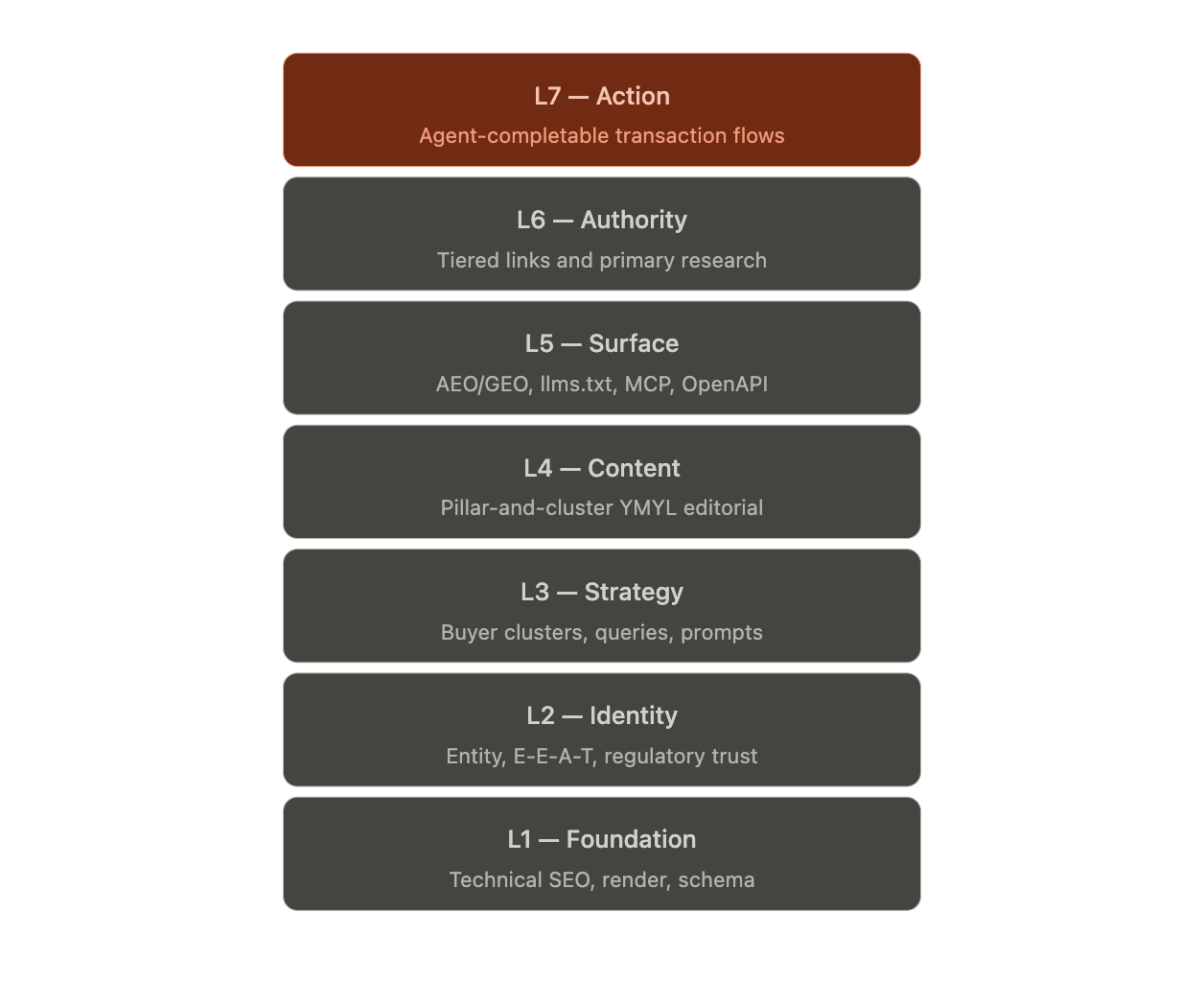
Seven disciplines stacked bottom-to-top, each engineered to perform across three search surfaces, all measured by an integrated loop. The framework is the spine of the rest of this guide.
The seven layers are: Foundation (technical SEO, schema, render, CWV), Identity (entity, E-E-A-T, regulatory disclosure), Strategy (buyer cluster, query map, AI prompt list), Content (pillar-and-cluster, YMYL editorial), Surface (AEO/GEO mechanics, llms.txt, OpenAPI, MCP), Authority (tiered links, primary research, analyst relations), Action (agent-completable transaction flows).
The three surfaces are: classic blue-link search (Google, Bing), the answer engines (ChatGPT, Perplexity, Gemini, Google AI Overviews), and the agentic web (autonomous AI agents browsing, deciding, transacting).
The measurement loop is: rankings on the priority query list, AI citation share across the answer engines, and pipeline attribution to revenue events – read on a fixed cadence, fed back into the strategy layer quarterly.
Each layer below maps onto a working chapter of the discipline. None of them are optional.
Keyword research and intent mapping for crypto
Generic keyword tools (Ahrefs, Semrush) will hand you thousands of “crypto” keywords. Most are worthless to your business. The job is to compress them into a working map.
Start from a buyer cluster – say Institutional Custody, Self-Custody, Stablecoin Treasury, Exchange Listings, DEX Liquidity, Lightning Payments, Mining Hosting, or Tokenization. Define four query archetypes inside each cluster: definitional (“what is qualified custody”), comparative (“BitGo vs. Anchorage vs. Fidelity Digital Assets”), evaluative (“how to choose a stablecoin platform”), and transactional (“Bitcoin custody for RIAs”). For each archetype, list the 15–30 queries that match. Score each on three columns – monthly search volume, intent strength for your business (1–5), and ranking difficulty against the actual SERP – and sort by intent first, volume second, difficulty third.
This produces a prioritized priority query list of 60–150 queries per cluster that maps cleanly to content. Refresh it quarterly. Watch SERP feature appearance (featured snippets, People Also Ask, Knowledge Panel, AI Overview presence) on each one weekly.
Build a parallel AI-prompt list alongside it. These are the 30–60 natural-language buyer questions that get typed into ChatGPT, Perplexity, Gemini, or Google AI Overviews – longer, more conversational, often comparative. They rarely look like keyword-tool queries, and they’re where AEO/GEO wins or loses.
Two crypto-specific lenses to apply on top: distinguish branded queries from category queries from comparison queries from policy/event queries (halving, ETF flows, GENIUS Act, MiCA, regulatory headlines). And keep a separate cyclical list for trending tokens, narratives, and policy events that you’ll publish into reactively – without letting that cyclical content cannibalize the evergreen base.
Pillar-and-cluster content for crypto YMYL
Scattered posts do not compound. Pillar-and-cluster does.
For each priority cluster, build a content asset that looks like this. One pillar page – the definitive 3,000–5,000-word resource on the cluster’s core topic. Eight to twelve supporting articles (1,500–2,500 words each) answering every adjacent question. One comparison hub (you vs. up to four named alternatives). One glossary owning definitional queries. One primary-research page with your own data – a custody benchmark, a corridor flow study, a treasury survey, a Lightning revenue analysis. One regulatory companion where the topic demands it. All internally linked.
Editorial rules that distinguish a winning cluster from a content-shop cluster. Every page is bylined by a named author with verifiable Bitcoin, crypto, fintech, or financial-services expertise. Every claim that can be cited is – to whitepapers, BIPs, regulator publications, on-chain data, named research (a16z, Castle Island Ventures, Coin Metrics, Galaxy, Fidelity Digital Assets, BIS, IMF, FSB), or your own primary data. Every page has a 4–8-question FAQ block. Every comparison page is honest about where you lose, not just where you win – that’s what makes it citable. Every pillar is updated quarterly with a visible “last updated” date because freshness is a ranking and citation signal in YMYL.
Length is downstream of completeness, not a target. Definitional and FAQ pages can be 800–1,500 words. Supporting articles 1,500–2,500. Pillars 3,000–5,000. Primary-research pages whatever the data needs.
Technical SEO for crypto and Web3 sites
You can’t out-write a crawl problem. Crypto and Web3 sites have a recognizable set of failure modes worth calling out.
Render the things you want indexed. Many crypto sites are JavaScript-heavy SPAs whose critical content (pricing pages, product feature pages, comparison tables, dApp interfaces) never reaches the crawler. Use server-side rendering, static generation, or proper hydration so the HTML Google fetches contains your actual content. Verify with Google’s URL Inspection tool and a curl test, not assumptions.
Hit Core Web Vitals. Google measures user experience through LCP (loading speed), INP (interactivity), and CLS (visual stability). Crypto sites struggle here due to heavy JavaScript, large hero images, third-party wallet scripts, and embedded chart libraries. Audit, defer, lazy-load, and replace third-party trackers with server-side analytics where possible.
Tame the docs site. Crypto and Lightning companies often have sprawling developer documentation that’s both an SEO goldmine (thousands of long-tail technical queries) and a crawl liability (duplicate content across versions, navigation traps, no canonical strategy). Force a canonical strategy across versions, add proper internal linking from your main domain into the docs, and decide deliberately what’s indexable.
Internationalize correctly. Crypto is one of the most international product categories on the internet, and most crypto sites botch hreflang – missing return tags, mismatched language codes, conflicting canonicals. Treat hreflang as a first-class engineering task.
Sitemap and indexation discipline. Submit clean XML sitemaps segmented by content type (pages, blog, docs). Noindex thin or duplicative pages aggressively. Audit Search Console coverage monthly. Watch for “Crawled – currently not indexed” spikes as an early warning of quality issues.
Per-bot robots.txt. This is the 2026 addition most crypto sites haven’t deliberated on. Decide per AI crawler – GPTBot, ClaudeBot, PerplexityBot, Google-Extended – whether to allow or disallow. Either choice is defensible; the mistake is to leave it on default. Your robots.txt should reflect a deliberate position per major AI crawler, documented internally.
Mobile performance. A significant share of crypto users access sites via mobile. Google’s mobile-first indexing means the mobile version determines rankings. Responsive design, touch-target sizing, font legibility, and navigation patterns all affect mobile usability scores.
The crypto schema stack
Schema markup makes your pages unambiguously machine-readable for both Google and the AI engines pulling citations. Most crypto sites ship none. The fix is methodical.
The minimum stack to deploy:
- Organization markup sitewide – full legal name, addresses, founding date, licenses, executive team, sameAs links to verified profiles (LinkedIn, GitHub, key socials, CEO’s LinkedIn, regulator pages where applicable). This is the entity backbone.
- FAQPage markup on every page with a Q&A block. This is rocket fuel for both featured snippets and AI answers. Match the question text to natural-language buyer prompts.
- Article with named author (linked to a real author page with credentials) and datePublished / dateModified on every editorial piece. Freshness signals matter in YMYL.
- FinancialProduct or FinancialService markup on product pages where applicable. Crypto-specific and underused – properly tagging a custody product, an exchange service, a Bitcoin yield product, or a stablecoin payment rail as a financial service is a clean entity signal.
- BreadcrumbList for architecture clarity.
- HowTo for genuine procedural content (setting up a Lightning node, configuring multisig, integrating an on-ramp API).
- Product plus aggregate Review if you have legitimate, structured reviews.
Validate with Google’s Rich Results Test and Schema.org’s validator. Watch Search Console for schema errors monthly. Schema doesn’t directly “boost rankings,” but it makes your content the easiest, most reliable thing for an answer engine to lift and cite – which is exactly the outcome that matters now.
AEO and GEO for crypto: optimizing for answer engines
Answer Engine Optimization (AEO) and Generative Engine Optimization (GEO) mean structuring content so AI models can find, trust, and cite it. They overlap heavily; in practice the terms are used interchangeably. The mechanics are knowable and the territory is still claimable for crypto specifically.
Lead with the answer. Each section opens with a direct, extractable, source-attributable statement in the first 1–2 sentences. The rest of the section elaborates. This “inverted pyramid” structure is what answer engines lift.
Use question-shaped headings. Map your H2s and H3s to the natural-language prompts in your AI prompt list. “What is qualified custody for Bitcoin?” is a better H2 than “Custody Overview.”
Write self-contained, quotable statements. Bullet-friendly, single-sentence facts with sources attached are massively more likely to be cited than long discursive paragraphs.
Maintain consistent entity language. Always describe your product and category the same way. AI engines build entity associations from repeated patterns; inconsistent naming weakens them.
Earn mentions on the sources models trust. Citation behavior across the major engines is driven heavily by which third-party sources mention you. For crypto, the high-signal sources are CoinDesk’s Bitcoin/policy desks, The Block research, Bitcoin Magazine, Galaxy, Fidelity Digital Assets, Coin Metrics, Glassnode, Castle Island Ventures, a16z, BIS, IMF, FSB working papers, regulator filings, and named academic papers.
Run the prompt battery. Define 30–60 buyer prompts per cluster. Run them across ChatGPT, Perplexity, Gemini, and Google AI Overviews on a fixed cadence (monthly minimum, weekly for hot clusters). Log citation share (cited / not), mention share (named without link), and risk-flag rate (mentioned negatively or with a competitor’s caveat). Watch the trend. Optimize against the gaps. AI citation share is the metric that distinguishes 2026-grade crypto SEO from 2022-grade content marketing.
Optimizing crypto sites for AI agents (the agentic web)
AI agents are now a measurable user segment on crypto sites. They behave differently from humans: they don’t scroll, they don’t tolerate flashy JavaScript, they don’t read marketing copy, they want structured facts and machine-readable interfaces, and on programmable money rails they can transact directly with your product.
Crypto is uniquely suited to host the agentic web. The money is programmable, the rails are open and queryable on-chain, and the buyer mental model already expects machine-to-machine workflows. The companies that ship action-grade agent flows in 2026 will own a customer segment competitors literally cannot serve.
The 2026 additions to make a crypto site agent-ready, beyond the standard SEO/AEO stack:
- A /llms.txt file at root pointing agents at clean markdown versions of your top pages.
- A considered per-bot robots.txt (allow/disallow GPTBot, ClaudeBot, PerplexityBot, Google-Extended deliberately).
- A public, versioned OpenAPI specification at a stable URL with rate limits, examples, and error semantics.
- An MCP server (Anthropic’s Model Context Protocol) exposing your top read-only capabilities – supported assets, pricing, quotes, status. Read-only first, transactional later.
- A /.well-known/agent.json-style manifest pointing agents at your API, MCP server, llms.txt, sitemap, pricing, and support surfaces.
- A pricing page with actual numbers and last-verified dates.
- Machine-readable comparison tables in HTML, not images.
- At least one production-grade transaction flow that a delegated agent can complete end-to-end – pricing, swap, deposit, withdrawal, settlement, or API payment. Supported by HTTP 402 / x402-style payment-required patterns where appropriate, scoped API keys, and session-key or signed-intent patterns with bounded scope.
This is the layer most crypto SEO guides simply do not have. It is also the layer where crypto can leapfrog every other category in 2026.
Crypto link building and digital PR
Authority signals matter as much as content for crypto YMYL search. But crypto links and mentions are not fungible – a single placement on the right source moves more than a hundred low-grade crypto-blog links.
Original primary research is the highest-leverage link bait. Build the data your category needs and doesn’t have: custody benchmarks, corridor flow studies, Lightning revenue surveys, on-chain analyses, ETF flow breakdowns, treasury allocation surveys, miner profitability studies. It earns links and citations on cadence for years.
Analyst-relations style placements. Brief named crypto researchers, ETF analysts, macro voices, and policy analysts on a calendar cadence. Some briefings end in citations; many end in soft mentions that still move the AI graph.
Expert commentary into the reactive PR cycle. Pitch named experts on your team into reporter rotations covering crypto policy, Bitcoin halving cycles, ETF flows, stablecoin regulation, Lightning growth, treasury moves. Reactive PR works in crypto because the news cycle is constant and the bench of credible voices is thin.
Honest comparison content. Pages that read like underwriting – you vs. named alternatives, with where you lose acknowledged – naturally earn citations when reporters and AI engines look for category overviews.
Avoid. Generic crypto-blog guest-post networks, low-quality PR-wire syndication, anything that looks like a link-buying scheme. These actively degrade the source-quality signal that AI engines weight heavily.
Why crypto SEO is harder than most categories
Five structural challenges, named so you can plan around them.
Regulatory uncertainty and compliance content. Regulations vary by jurisdiction (US GENIUS Act, EU MiCA, Singapore MAS, UAE VARA/DFSA, UK FCA) and change frequently. Content about token offerings, staking, custody, stablecoins, and exchange services requires careful disclaimers, regional variants, and quarterly refresh.
Anonymous or pseudonymous teams and E-E-A-T. Google’s quality systems weight named, credentialed authorship heavily. Many crypto projects have anonymous core teams. The solution is rarely to doxx the protocol team – it’s to build a credible human layer around the money content with named authors, advisors, and verifiable credentials.
Market volatility shifts search behavior. Bull and bear markets dramatically change query mix. A comprehensive content approach balances trending and evergreen content so the program doesn’t collapse with the market.
Competition from established exchanges and fintechs. Coinbase, Binance, Kraken, Fidelity Digital Assets, and similar players dominate high-volume queries with massive domain authority. Competing directly for “buy bitcoin” is unrealistic for most projects. Long-tail, comparison, and bottom-funnel queries offer better opportunities – “best DeFi lending protocol for stablecoins” has lower volume but also lower competition and higher intent.
Distribution-channel restrictions. With paid channels restricted, the SEO program carries disproportionate load. There is no fallback if the foundation, content, or authority layer is weak.
Measuring crypto SEO performance
A modern crypto SEO program measures three layers at once. Skipping any layer is flying with one eye closed.
Rankings. Track your priority query list (60–150 per cluster) weekly. Watch movement, watch volatility, watch SERP feature appearance (featured snippets, People Also Ask, Knowledge Panel, AI Overview presence). Segment by intent (informational, comparative, transactional) and by cluster.
AI citations. The prompt-battery output. Citation share, mention share, risk-flag rate per engine, per cluster, monthly minimum. Chart the trend. This is the single most underpriced metric in crypto marketing.
Pipeline. Connect organic, AI-referral, and agent sessions to actual conversion events – demo bookings, account opens, API signups, sandbox starts, RFP starts, contract starts, agent-completed transactions. UTM discipline that survives sales handoff. Server-side analytics. Warehouse plus reverse-ETL to tie sessions to opportunities.
A monthly executive crypto SEO report should cover, at minimum: keyword ranking summary on the priority query list, citation share across the major AI engines, organic and AI-referral sessions, pipeline events attributed, schema and technical health, backlink and mention graph movement, and competitor share of voice on the key terms.
The reporting cadence that works: weekly tactical, monthly executive, quarterly strategic. Anything more granular and you spend more time reporting than improving.
The 90-day crypto SEO sprint sequence
Strategy doesn’t compound without sequencing. Here’s how to actually run the framework in 12 weeks.
Sprint 1 (weeks 1–2): foundation. Technical and YMYL audit. Fix render, CWV, indexation, hreflang. Deploy Organization and FAQPage schema sitewide. Ship credible author bylines, About page, security and compliance hub. Decide and ship the per-bot robots.txt. Ship the /llms.txt.
Sprint 2 (weeks 3–4): map. Build the priority cluster’s keyword + intent map (60–150 query priority list). Define the AI prompt battery (30–60 prompts). Capture baseline rankings and baseline citation share.
Sprint 3 (weeks 5–6): pillar. Publish the pillar page for cluster one. Structure for AEO/GEO extraction. Deploy Article + FinancialProduct + FAQPage schema. Internal-link from existing relevant pages.
Sprint 4 (weeks 7–8): cluster. Publish 4–6 supporting articles around the pillar. Comparison page if applicable. Glossary entries. Internal-linking discipline.
Sprint 5 (weeks 9–10): authority. Scope and brief the first piece of original primary research. Pitch named experts into the reactive PR cycle. Stand up the analyst-relations target list and the first round of outreach.
Sprint 6 (weeks 11–12): instrument. Pipeline attribution wired up (UTM discipline, server-side analytics, warehouse joins). First monthly executive report shipped. Cluster two queued. Read the loop. Recalibrate.
Day 90, you should have: a technically clean crypto site that loads fast and crawls cleanly, one pillar + 4–6 supporting pieces ranking or moving in a priority buyer cluster, a baseline and trendline for AI citation share across ChatGPT, Perplexity, Gemini, and AI Overviews, one or two credible third-party placements, and pipeline attribution that survives a CFO question. That’s a winning starting position.
When to hire a crypto SEO agency (and how to choose one)
Five signals indicate the need for external expertise: no in-house SEO depth on the team; organic growth has stalled despite publishing; an upcoming funding round, token-generation event, or product launch needs visibility quickly; compliance and YMYL content is a recurring blocker; or AI citation share is invisible because no one is measuring it.
Five questions cut through the noisy “crypto marketing agency” market quickly when evaluating one.
One: show me a crypto-specific case study with rankings, citations, and pipeline. Not just impressions. Vague answers mean vague work.
Two: how do you measure AI citations? The right answer is concrete – a defined prompt battery per buyer cluster, fixed-cadence runs across at least ChatGPT, Perplexity, Gemini, and Google AI Overviews, and reported metrics for citation share, mention share, and risk-flag rate. Vague answers mean they don’t measure it.
Three: who writes the YMYL content and what are their credentials? Real bylines, real subject-matter depth, real review process. A pseudonymous content farm will sink your E-E-A-T faster than no content at all.
Four: what’s your link and PR list – and how do you earn placements? You want named crypto-credible outlets, regulator-adjacent citations, and primary-research-led PR. If the answer is “guest posts on crypto blogs,” walk away.
Five: how do you tie this to revenue? Demo bookings, account opens, API signups, qualified inbound – not sessions. If reporting stops at traffic, you’ll never know if the program is working.
Bonus question: does the agency rank for the keywords it’s pitching you? It’s the cleanest tell in the market.
FAQs about crypto SEO
What is SEO in crypto?
SEO in crypto is the practice of optimizing crypto, blockchain, stablecoin, exchange, wallet, and Web3 websites to rank in search engines (Google, Bing) and earn citations from AI answer engines (ChatGPT, Perplexity, Gemini, Google AI Overviews) for the queries crypto buyers, developers, and institutions actually run. It applies traditional SEO disciplines – keyword research, content, technical foundations, and authority – to crypto’s specific constraints: YMYL content scrutiny, restricted advertising channels, volatile keyword cycles, and fintech-grade competition.
Most crypto projects see measurable ranking improvements within three to six months. Meaningful traffic growth and pipeline contribution compound over six to twelve months, depending on competition, starting domain authority, and content velocity. Foundational and AEO/GEO wins often appear inside the first quarter. It is a moat, not a hack.
Bitcoin SEO targets a more institutional buyer set, a fintech-dominated SERP, and a particularly hot answer-engine layer. Altcoin SEO often focuses on lower-competition, longer-tail terms and a more crypto-native audience. The disciplines share a foundation but the buyer, the trust signals, and the comparison set differ enough that the playbooks diverge.
Crypto SEO is the discipline of ranking pages in classic search engines (Google, Bing). Crypto AEO – Answer Engine Optimization – is the discipline of being cited as a source by AI answer engines (ChatGPT, Perplexity, Gemini, Google AI Overviews). They share most of the same foundations but reward overlapping-but-distinct moves on the content and authority layers. A 2026-grade program runs both inside a single framework rather than as separate programs.
Yes. SEO can be built through product pages, documentation, landing pages, comparison hubs, glossary libraries, and primary-research pages. A blog is one of the most effective ways to target informational queries and build topical authority, but it is not the only way – and product-page SEO (especially for stablecoin platforms, exchanges, custodians, and wallet companies) is often where revenue actually closes.
A credible crypto SEO engagement typically lands in the mid-five to mid-six figures monthly depending on scope (technical fixes, content velocity, primary research, PR, AEO/GEO measurement). Buy below that range and you’re usually paying for blog posts mislabeled as SEO. Buy above it and you’re paying for an integrated growth function.
The seven layers of the Crypto Search Stack – Foundation, Identity, Strategy, Content, Surface, Authority, and Action – serving three surfaces (blue-link search, answer engines, the agentic web), bound by one measurement loop (rankings → citations → pipeline → recalibrate quarterly).
Optimize for the discipline once and measure separately. The mechanics that drive citation share are largely the same across engines (lead with answer, schema, question-shaped headings, consistent entity language, third-party mentions on trusted sources, freshness). The measurement is engine-specific because each major engine cites differently – track citation share per engine, per cluster, monthly minimum.
YMYL stands for “Your Money or Your Life” – Google’s category for content that can affect a person’s finances or wellbeing. Crypto pages are unambiguously YMYL because they’re about money, custody, payments, yield, and risk. That raises the quality bar and weights E-E-A-T (Experience, Expertise, Authoritativeness, Trust) signals more heavily in ranking and citation decisions.
AI agents are increasingly a third class of “user” – autonomous software acting on a person’s behalf. Crypto sites optimized for agents are discoverable (Layer 1 of the framework), trusted (Layers 2 and 6), usable (Layer 5 – OpenAPI, MCP, /llms.txt), and action-completable (Layer 7). Crypto is the first category where the agent can be a full commercial actor because the money is programmable.
A prompt battery is a defined set of 30–60 natural-language buyer questions, run on a fixed cadence across the major AI answer engines (ChatGPT, Perplexity, Gemini, Google AI Overviews), and logged for citation share, mention share, and risk-flag rate. It is the instrument that lets you measure AI citation visibility the way you measure keyword rankings. Programs without one are flying blind on the fastest-growing research surface in their funnel.
The takeaway
Crypto SEO in 2026 is no longer one discipline. It is three surfaces – blue-link search, answer engines, the agentic web – running on seven shared layers, bound by one measurement loop. A program that addresses one surface and ignores the others is increasingly a program that compounds in one place and quietly loses ground in the other two. A program that runs all three through the same framework compounds everywhere.
Score where you stand on the seven layers. Pick the lowest. Ship the next sprint. Run the loop. Then do it again.
ColdChain is a performance-first SEO, AEO, GEO, and agent-readiness agency for crypto, blockchain, stablecoin, exchange, wallet, and DeFi companies. We run the Crypto Search Stack as our working framework – and we measure programs on rankings, citation share across the major AI engines, and pipeline (including agent-attributable revenue), not impressions. Book a crypto SEO audit →
Sources and further reading: Google Search Quality Rater Guidelines (YMYL, E-E-A-T); a16z, Castle Island Ventures, Coin Metrics, Galaxy, Fidelity Digital Assets, BIS, IMF, FSB stablecoin and crypto research; Anthropic Model Context Protocol documentation; emerging llms.txt and HTTP 402 / x402 patterns; named regulator publications (US GENIUS Act, EU MiCA, Singapore MAS, UAE VARA/DFSA, UK FCA); ColdChain internal AEO/GEO and agent-traffic measurement framework.


